
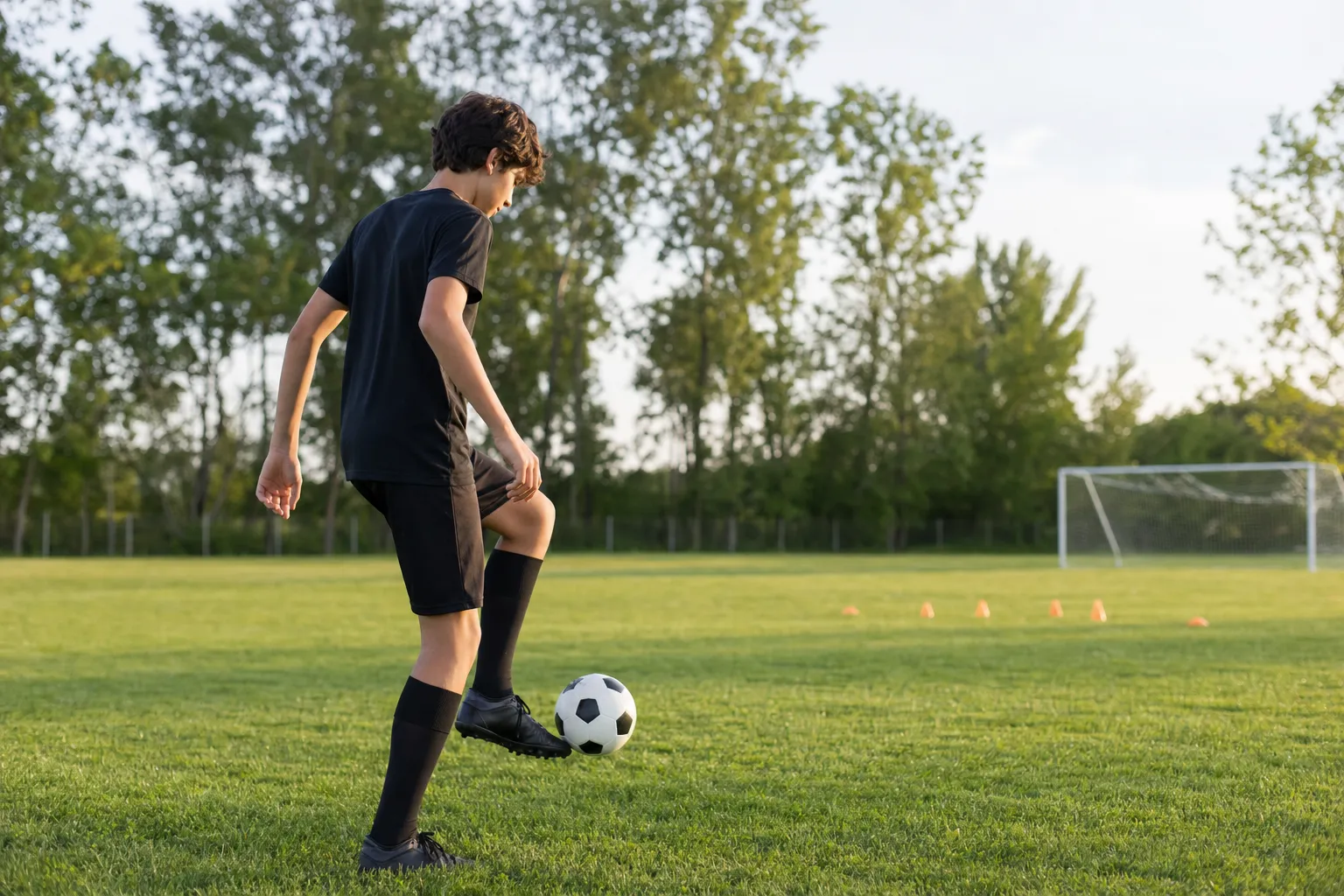
Soccer tryout drills are most useful when they prepare a player for the moments that actually happen in a session: receiving under pressure, moving after a pass, defending a small space and making the next decision before the ball arrives. The best practice is not a collection of complicated tricks. It is a short routine that makes the player calmer and more comfortable when the game speeds up.
This guide gives young players and parents eight practical ways to prepare. Most need only a ball, a few cones or safe markers, and a small area to work. Use them over several days, keep the work fun and finish before the player is worn down. Tryouts reward repeatable habits, not a last-minute training marathon.
BUILD A SHORT PRACTICE PLAN FIRST
Before picking drills, decide what a normal week can realistically hold. Two or three sessions of 30 to 45 minutes are plenty for many young players before a tryout. Start with a light warmup, work on one or two ball skills, then add a decision-making activity or a small game. Keep at least one easier day before the tryout so the player arrives ready to compete.
A helpful session has a simple purpose. One day may focus on first touch and passing. Another may focus on dribbling and defending. A third may put those skills into a small game with siblings or friends. The player should leave each practice knowing what they improved, rather than feeling buried under instructions.
FC National's development approach centers technical ability, game understanding, movement and mindset together. That is a useful lens for every drill below. Ask, “Does this help the player see, decide or execute something they will use with teammates?” If the answer is no, it may be fun, but it is not the most useful tryout preparation.
1. PASS, RECEIVE AND MOVE
Find a partner or a wall. Set two markers about five to eight yards apart. Pass the ball with the inside of the foot, receive it with the back foot when possible, then move a step or two before the next pass. Begin slowly enough that the ball stays on the ground and the touch is clean. As the player becomes comfortable, add a rule: two touches maximum, or call out which foot they will use before the ball arrives.
This drill builds the habits that are easy to overlook because they are not flashy. A good pass has the right weight. A first touch creates a useful next action. Movement after the pass gives the teammate another option. At a tryout, those small actions help a player stay connected to the group instead of waiting for the ball to come back.
For younger players, a wall is enough. For older players, have the partner change the angle or speed of the pass. The goal is not to make the drill difficult for its own sake. It is to help the player adjust their feet, scan early and keep the ball moving.

2. TAKE THE FIRST TOUCH AWAY FROM PRESSURE
Place one cone a few steps in front of the player and a second cone to either side. Have a partner pass the ball in. Before the ball arrives, the player looks over one shoulder, opens their body and takes the first touch toward one of the side cones. Then they pass back or dribble into the next space. Switch sides often so both feet are involved.
The key is the first touch, not speed. Players can get trapped when the ball stops under their feet or rolls straight into a defender's path. A touch into open space gives the player a moment to look up and choose. Coaches notice this because it makes the game easier for everyone around the player.
Use the simplest version that stays clean. If the player is still fighting the ball, slow the pass down and widen the cones. Once the touch is reliable, make the space smaller or let the partner call a side late. That small uncertainty creates the kind of adjustment players need in real game moments.

3. DRIBBLE WITH A CLEAR EXIT
Set up four to six cones in a loose line. Dribble through them with small touches, then accelerate for five yards out of the final cone. The player should use both feet and keep the ball close enough to change direction. Repeat in the other direction, then change the pattern so it does not become a memorized dance.
Tryout dribbling is rarely about beating every player on the field. It is about controlling the ball when there is a little room, changing direction when pressure arrives and knowing when to release the pass. Add a partner at the end of the course if possible. The player dribbles through the cones, exits with speed, then makes a simple pass instead of carrying the ball too long.
Keep the body low, take light touches and let the player look up between touches. A player who can see while dribbling is more likely to notice a teammate or a defender. That is far more useful than staring at the ball and finishing the cone pattern perfectly.
4. PRACTICE THE SIMPLE TURN
Use one cone as a defender. Dribble toward it, stop the ball with the sole or inside of the foot, turn away and accelerate into space. Practice a few turns the player can repeat comfortably: an inside cut, an outside cut, a pullback or a simple drag turn. There is no prize for adding a move the player does not trust.
Ask the player to name where the pressure is coming from. If it is from the left, can they turn right? If the defender is behind them, can they protect the ball and find the next pass? The drill becomes more useful when it connects the turn to a reason, rather than treating it as a trick.
At a tryout, a clean turn can be a quiet sign of composure. The player does not need to beat someone with a highlight move. They need to protect the ball, get out of trouble and help the team keep possession.
5. DEFEND A SMALL SPACE
Set up a small square and play one-on-one for short rounds. The attacker tries to dribble over a line or through two small gates. The defender starts a few steps away and works on arriving under control, staying balanced and steering the attacker toward the edge instead of diving in.
Defending drills matter because a tryout shows what a player does after possession changes. A player who reacts quickly, closes down without fouling and keeps working after being beaten can stand out even without scoring. Encourage the defender to bend their knees, use short quick steps and watch the ball without forgetting the attacker's body position.
Keep the rounds brief, about 20 to 30 seconds. That lets the player compete with energy and reset often. Switch roles so the player learns what makes a defender difficult to beat. The best outcome is not a pile of tackles. It is better control of distance, timing and effort.
6. MAKE A DECISION BEFORE THE BALL ARRIVES
This can be added to almost any passing drill. Place three colored cones or simple markers around the player. Before the pass, a partner calls a color. The player checks that space, receives the ball and plays or dribbles toward the named marker. If there is no partner, use a parent or sibling to point after the ball is passed.
The activity trains scanning. In a tryout, a player rarely has time to decide after the ball is already at their feet. Looking around early helps them recognize pressure, teammates and the next open space. It also makes the player appear more settled because the next action starts sooner.
Keep the instruction simple at first. One color, one decision, one touch toward the space. Then add a choice: if the red cone is called, turn and pass; if the blue cone is called, dribble. The player is not being tested on memory. They are learning to take in a cue, choose and act.

7. PLAY SMALL-SIDED GAMES
A simple 2v2, 3v3 or 4v4 game may be the most valuable soccer tryout drill of all. Small-sided games give players more touches, more transitions and more chances to solve a problem with teammates. Use small goals, end zones or gates. Rotate teams and keep games short enough that everyone stays involved.
Encourage players to notice three moments: what they do before receiving, what they do immediately after passing and how they react when the ball is lost. Those moments show a player's awareness and work rate. They also make the game more enjoyable because nobody is standing around waiting for one person to dribble through everyone.
U.S. Soccer's Talent Identification approach looks at potential and progression rather than one isolated moment. A club tryout is different, but the principle holds. Small-sided play gives a player more chances to show consistent habits than a single line drill ever can.
8. FINISH THE SESSION WITH A SIMPLE RESET
End each practice with a short challenge that feels achievable. It might be ten clean passes with each foot, five controlled turns, a one-minute juggling target or a small game to three goals. Finishing with something the player can do well builds confidence without pretending every session has to be perfect.
Then stop. Young players do not need a punishing final workout the night before tryouts. The American Academy of Pediatrics advises young athletes to build performance around regular food, fluids, training and rest instead of shortcuts or products that promise an edge. Its guidance on performance-enhancing substances in youth sports is a useful reminder that the basics still matter most.
On tryout day, pack familiar gear, arrive with enough time to settle and keep the player's message simple: compete, communicate and recover quickly after mistakes. The detailed plan in FC National's soccer tryout tips guide can help with the final week and the day itself, while this parent guide to how tryouts work explains what families can expect at the field.
A SIMPLE SOCCER TRYOUT DRILLS CHECKLIST
- Choose two or three short sessions: practice consistently instead of cramming.
- Use both feet: include passing, receiving and dribbling on each side.
- Practice the first touch: move the ball away from pressure, not toward it.
- Add one decision: scan, call a color or choose an exit before receiving.
- Compete in a small game: practice supporting teammates and reacting to transitions.
- Finish fresh: leave recovery time so the player arrives ready to play.
FC NATIONAL TRYOUTS
PUT THE PRACTICE TO WORK.
FC National uses tryouts to help place players in a competitive environment that fits their current stage of development. Ask the club about current dates, age groups and registration details.
ASK ABOUT TRYOUTS →FREQUENTLY ASKED QUESTIONS
What drills should a player do before soccer tryouts?
Start with drills that show up constantly in games: receiving and passing, turning, dribbling with a change of direction, defending in a small space and playing small-sided games. The goal is to arrive comfortable with the ball and ready to make simple decisions, not to learn a long list of tricks.
How often should a player practice before soccer tryouts?
A few short, purposeful practices each week are usually more useful than a sudden jump in training. Build around the player's normal schedule, include recovery time and keep the final session light enough that they arrive fresh. If the player is injured or unusually fatigued, speak with an appropriate health professional and the club.
Do soccer tryout drills need a full field?
No. A driveway, small patch of grass, wall or park space can work for many skills. Use a ball, a few cones or safe markers and enough room to move. Small spaces can be especially useful for first touch, quick decisions and changing direction.
What do coaches look for during soccer tryouts?
Coaches often look beyond goals and flashy moves. They notice first touch, awareness, work rate, communication, coachability and how a player responds after losing the ball or making a mistake. A player who helps the group function can make a strong impression throughout the session.
RELATED POSTS
 PLAYER GUIDE
Soccer Tryout Tips: 8 Ways to Prepare and Stand Out
Eight practical soccer tryout tips for young players: what coaches notice, how to prepare and how to stay composed on the day.
 PARENT GUIDE
How Soccer Tryouts Work: What Parents Can Expect
A parent guide to youth soccer tryouts, from check-in and drills to coach decisions, follow-up and the questions worth asking.