
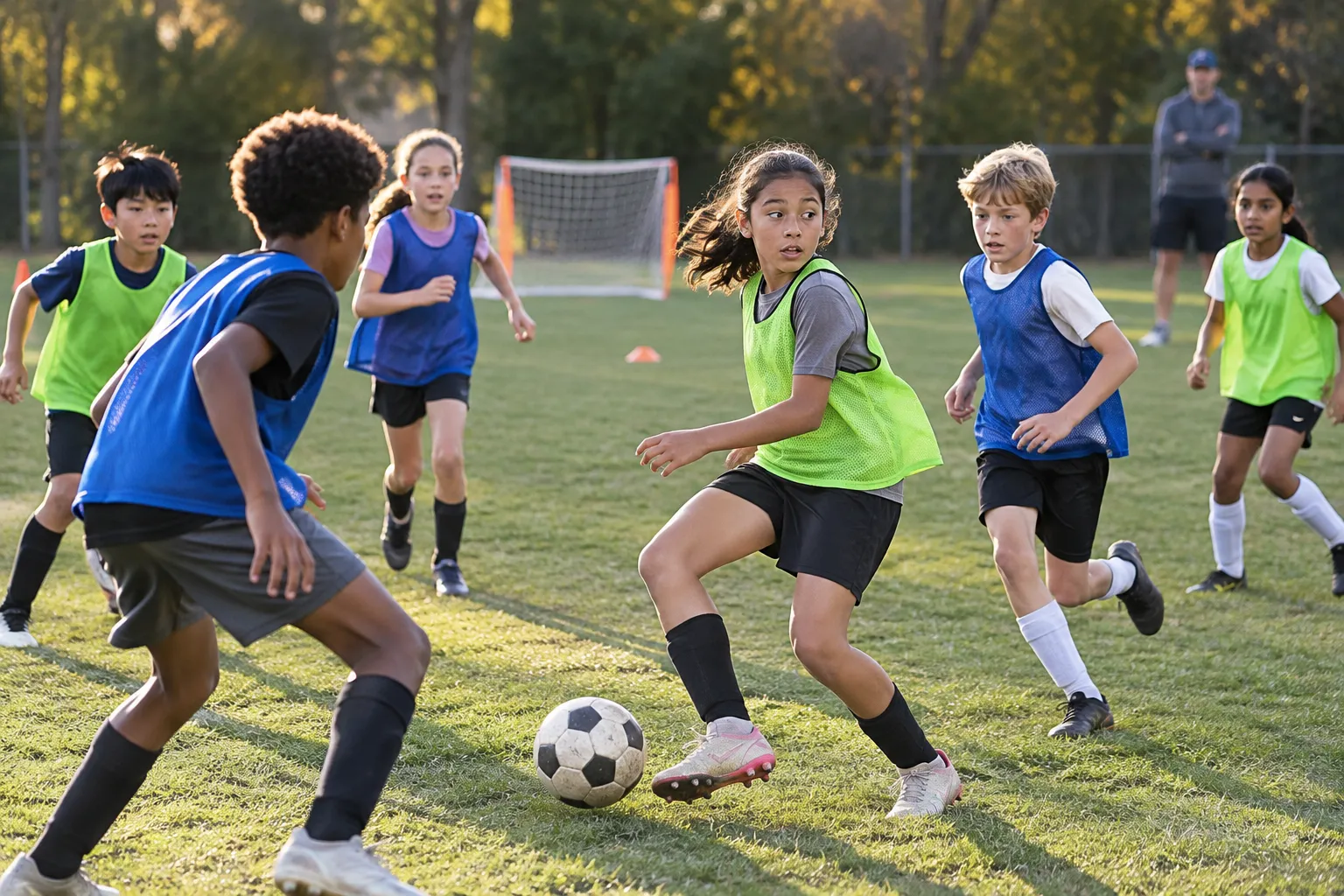
Ten-year-olds are ready for soccer activities that ask for more than a clean touch. They still need plenty of time with the ball and a practice that feels like play, but they can begin to recognise pressure, find an open teammate and recover quickly when a move does not work. The aim is not to turn a young player into a miniature professional. It is to give them useful problems, enough repetitions and the confidence to try a solution.
These soccer drills for 10 year olds build toward that next stage. Each activity has a simple setup, then adds a choice, an opponent or a small game. Use cones, shoes or water bottles as markers, keep the groups small and show the idea once before letting the players get started. If players are waiting in a line, add another ball, another gate or another small field.
WHAT 10 YEAR OLDS NEED FROM PRACTICE
Players around ten can sit at the edge of the U9-U10 and U11-U12 stages, depending on the competition calendar. U.S. Soccer's U11-U12 age-group guide points to combination play in small groups, short and long passing with both feet, 2v1 situations, acceleration and deceleration, and small-sided games. Those are useful ideas for a parent or volunteer coach planning an active hour.
The change from the younger ages is not a complicated playbook. It is a little more awareness. A player can receive while looking for the next pass, notice when a teammate needs support and learn that winning the ball creates a new attacking opportunity. U.S. Soccer's Play-Practice-Play approach is a helpful reminder to let a game frame the session, then give players a focused activity before returning to play.
1. TWO-GATE SCAN AND PLAY
Set two cone gates about eight yards apart, with a player on each side and one player in the middle. The middle player checks away, receives a pass, opens their body and plays through the other gate. After passing, they move to the outside and a new player comes into the middle. Use two or three groups so every player stays involved.
At first, ask the receiver to look over one shoulder before the ball arrives. Later, have the passer call a colour or number that tells the receiver which gate to use. The receiving player should not guess. They need to scan, take a first touch toward the chosen space and play a pass that gives the next teammate a chance to move.
Keep the coaching cue short: look, open, play. A player who takes an imperfect touch but sees the next action is learning something more useful than a player who waits for a perfect ball. If the group is struggling, make the gates wider and reduce the passing distance. When they settle, shrink the space or add a defender who can intercept but not tackle.

2. PASS, MOVE AND SUPPORT
Make a rectangle about 18 by 24 yards and place three or four cone gates around it. Play 3v3 or 4v4 inside the rectangle. A team scores a point by completing a pass through any gate to a teammate. The player who passed must move to a new angle before they can receive again. No team may score through the same gate twice in a row.
This game helps players see that passing is not the end of their job. After the ball leaves their foot, they need to create a fresh option. Encourage teammates to spread out rather than follow the ball in a group. The best spaces are often to the side of the defender, not directly behind a teammate.
When the game becomes too easy, limit the attacking team to three touches. When it becomes frustrating, add a neutral player who always helps the team with the ball. The extra player gives everyone a better chance to recognise support angles and make combinations that feel like real soccer rather than a passing line.
3. 2V1 BREAKOUT
Use a channel about 12 yards wide and 20 yards long. Two attackers start at one end with a defender between them and a small goal or end gate at the far end. The attackers try to get through the goal together, while the defender tries to delay or win the ball. Keep each round to fifteen seconds, then rotate quickly.
The player on the ball has a real question to answer: can they dribble past the defender, or is the teammate open for a pass? The supporting player has an equally useful job. They need to stay far enough away to make the defender choose, but close enough to help if the ball carrier is trapped. That is a simple introduction to width, timing and communication.
Begin with the defender arriving a step late so the attackers can recognise the picture. Then make it live. If the defender wins the ball, let them dribble out through the starting gate for a point. That turns a losing moment into an immediate transition and keeps every player alert.
4. 1V1 CHANGE OF DIRECTION
Build a square with a cone gate on each side. One attacker starts with the ball inside the square while a defender begins a few steps away. On the signal, the attacker tries to dribble through any gate. The defender tries to keep the ball in front of them, close the space and win it fairly. Play for twenty seconds, then switch roles.
The attacker can use a simple move: an inside cut, an outside touch, a pullback or a change of speed. The defender is practising patience. They do not need to tackle immediately. They can slow the attacker, stay balanced and wait for the touch that moves the ball too far away.
Make the square larger for players who need time and smaller for a confident group. Use a clear safety rule with no sliding tackles or pushing. Praise brave attempts and quick recovery. A player who loses the ball, turns and tries to win it back has practised an important game habit.

5. FOUR-GOAL SWITCHING GAME
Set up a 25 by 30 yard field with a small goal in each corner. Play 4v4, with each team attacking two goals. A team can score in either target, so the player on the ball must look across the field rather than simply run toward the nearest goal.
At this age, a four-goal game makes the value of width easy to feel. When one side is crowded, a player may be able to turn out and find a teammate near the far target. Ask questions during natural breaks: Which goal is open? Where could you move to give the ball carrier an option? What changed when we won the ball back?
For a progression, require a pass before a team can score. For a simpler version, use one extra attacker. Keep the score close enough that the game matters, but do not stop play for every correction. Let the game create the picture, then give players one clear idea to try on the next round.
6. WIDE PLAYER FINISHING
Use a small field with a goal at one end and two wide channels marked by cones. Play 3v2 toward goal. The attacking team earns the right to finish after a pass travels through either wide channel. The player receiving wide can dribble inside, pass to a teammate or play a simple ball across the goal.
This is not about memorising a pattern. It gives players a reason to recognise a crowded middle and use a teammate who has space. The player in the wide channel learns to receive with their body open and make a quick choice. The central players learn to arrive near the goal without all standing in the same place.
Start without goalkeepers and use a small target goal if that keeps the game moving. Later, let another player rotate into goal. U.S. Soccer's U9-U10 game guidance encourages players to experience different roles, which helps a young player understand how teammates see the game.
7. 4V4 TRANSITION GAME
Finish with a game on a compact field with two small goals. Play 4v4, or 3v3 if the group is smaller. Each time the ball goes out, a goal is scored or possession changes, restart quickly from the coach or the closest player. Keep the rounds to four minutes so everyone gets several chances to compete and reset.
Choose one focus from the earlier activities. It might be moving after a pass, looking up before receiving or reacting in the first few seconds after losing the ball. The game gives that idea a purpose. Players discover that a good pass creates another job, and that a quick response after a turnover can win the ball back.
Do not over-coach the final game. Let the players play, then use one short question between rounds. A simple reflection such as “When did you find the open side?” helps a ten-year-old connect the drill to the decisions they just made.

A SIMPLE 60-MINUTE SESSION
- Minutes 1 to 8: Free dribbling, movement and a short 2v2 game.
- Minutes 9 to 17: Use Two-Gate Scan and Play.
- Minutes 18 to 27: Play Pass, Move and Support.
- Minutes 28 to 37: Run 2v1 Breakout or 1V1 Change of Direction.
- Minutes 38 to 47: Use Four-Goal Switching or Wide Player Finishing.
- Minutes 48 to 60: Finish with the 4V4 Transition Game and a quick player reflection.
Use the schedule as a guide, not a command. Stay with the activity that has players solving problems and smiling. If an exercise is too easy, add a defender, tighten the space or ask for the other foot. If it is too difficult, widen the area, add a neutral player or give the player an extra touch. Good practice is not about making every child do the same thing perfectly. It is about helping each player find a challenge they can work through.
HOW TO ADAPT THE GAMES FOR YOUR GROUP
Ten-year-olds develop at different rates. One player may be ready to scan before every reception, while another is still building confidence with a moving ball. Keep the main game the same, then change one variable. More space and fewer defenders create time. Less space, a touch limit or an extra defender add pressure. This gives every player a genuine chance to improve without separating the group into labels.
For a small group at home, use a wall as a teammate. A player can pass to the wall, scan for a marker behind them, then take the return pass through a different gate. Keep the task short and let the player choose a score to beat. A focused ten minutes with a ball is more useful than a long session that feels like a test.
Make room for the player's voice too. Ask what they saw when the move worked, which turn felt easiest or where they found space in the game. Players learn more when they can describe a decision in their own words. A parent or coach does not need to supply every answer.
HOW FC NATIONAL SUPPORTS PLAYER DEVELOPMENT
FC National's player development approach connects technical skill, game understanding, movement and mindset over time. For players around ten, that means purposeful training with plenty of ball contact, age-appropriate pressure and games that reward awareness as well as effort.
Families can explore FC National teams, meet the coaching staff and review current tryout information when considering the next step. The best environment is one where a player can be challenged, enjoy the work and keep growing.
FC NATIONAL DEVELOPMENT
LET THEM PLAY. HELP THEM GROW.
FC National gives ambitious young players a competitive environment built around purposeful training, patient coaching and long-term development.
ASK ABOUT TRYOUTS →FREQUENTLY ASKED QUESTIONS
What soccer skills should a 10 year old practice?
Ten-year-olds benefit from regular work with both feet, including first touch, dribbling, passing, receiving, turning, defending and finishing. The biggest next step is linking those skills to a decision. Small-sided games give players a reason to scan, support a teammate and react when the ball changes hands.
How long should soccer practice be for a 10 year old?
A focused 60 to 75 minutes is often enough for a team session. Keep explanations brief, make water available and change the activity before players spend long periods in line. The best practice leaves a player tired from playing, not from waiting.
Should 10 year olds learn positions in soccer?
Players can begin to understand how wide, central and defensive roles affect a game, but they should still experience different positions. At this age, rotating roles helps a player see the game from more than one viewpoint and builds empathy for teammates.
How can parents help a 10 year old practice soccer at home?
A ball, a safe wall, a few markers and a little space are enough. Keep it short and specific: use both feet to pass to a target, dribble through a course, then finish with a game against a personal score. The goal is frequent, enjoyable contact with the ball, not a long correction session.
RELATED POSTS
 PLAYER GUIDE
Soccer Drills for 9 Year Olds: 7 Fun Games
Seven fun soccer drills for 9 year olds that build first touch, passing, defending and smarter decisions through active games.
 PLAYER GUIDE
Soccer Drills for 8 Year Olds: 7 Fun Games
Seven simple soccer drills for 8 year olds that build ball control, confidence and game awareness while keeping practice fun.
 PLAYER GUIDE
Soccer Tryout Drills: 8 Ways to Practice With Purpose
Eight simple soccer tryout drills that help young players prepare their touch, decisions, movement and confidence.